
Access New York City Criminal Court Records
Criminal court records in New York City span five boroughs and five counties. Each borough has its own Criminal Court for misdemeanors and a Supreme Court that handles felony cases. The city processes tens of thousands of criminal cases each year across Manhattan, Brooklyn, Queens, the Bronx, and Staten Island. You can look up pending cases through the state's free WebCrims system. For older records or certified copies, you need to contact the specific borough court or use the statewide Criminal History Record Search run by the Office of Court Administration.
New York City Overview
Criminal Court Records by Borough
New York City is unique. It covers five boroughs, and each one is also a county. Manhattan is New York County. Brooklyn is Kings County. Queens is Queens County. The Bronx is Bronx County. Staten Island is Richmond County. Each has its own Criminal Court that handles misdemeanors and violations. Felony cases go to the Supreme Court in each county.
The NYC Criminal Court system is separate from the rest of the state. It was set up under the New York City Criminal Court Act. The court handles arraignments, bench trials, plea hearings, and sentencing for misdemeanor charges. When a felony arrest happens, the Criminal Court holds the first hearing. If a grand jury returns an indictment, the case moves to Supreme Court for trial.
Manhattan (New York County)
Manhattan Criminal Court is at 100 Centre Street, New York, NY 10013. This is one of the busiest criminal courts in the world. The Manhattan District Attorney's Office at 1 Hogan Place handles all prosecutions. Phone: (212) 335-9000. The DA's office has units for homicide, special victims, cybercrime, and major economic crimes. Criminal court records for Manhattan can be found through WebCrims or by visiting the court clerk at 100 Centre Street.
Brooklyn (Kings County)
Kings County Criminal Court is at 120 Schermerhorn Street, Brooklyn, NY 11201. The Brooklyn District Attorney's Office prosecutes all cases in this borough. Felony cases go to Kings County Supreme Court at 320 Jay Street. The County Clerk maintains records of felony proceedings. For misdemeanor records, contact the Criminal Court clerk.
Queens
Queens Criminal Court is at 125-01 Queens Boulevard, Kew Gardens, NY 11415. The Queens District Attorney's Office prosecutes crimes here. Queens County Supreme Court handles felony trials. Records are kept by the court clerk and can be searched through WebCrims for pending matters.
The Bronx
Bronx Criminal Court operates at 215 East 161st Street, Bronx, NY 10451. The Bronx County Clerk's Office is at 851 Grand Concourse, phone 718-298-0600, open 9 AM to 4:45 PM Monday through Friday. Felony cases are tried in Bronx County Supreme Court. The Bronx District Attorney's Office handles prosecutions for the borough.
Staten Island (Richmond County)
Richmond County Criminal Court is at 67 Targee Street, Staten Island, NY 10304. This is the least busy of the five borough courts. Felony cases move to Richmond County Supreme Court at 18 Richmond Terrace. The county maintains records through the standard NYS court system.
How to Search New York City Criminal Court Records
There are a few ways to look up criminal court records in New York City. The method you use depends on what you need and how old the case is.
WebCrims is the free online tool for pending criminal cases. It covers all five boroughs. You can search by name, case number, or docket number. The system shows case status, charges, court dates, and judge assignments. Go to the NYS Courts website to use it. It does not show sealed cases or cases that ended more than a few years ago.
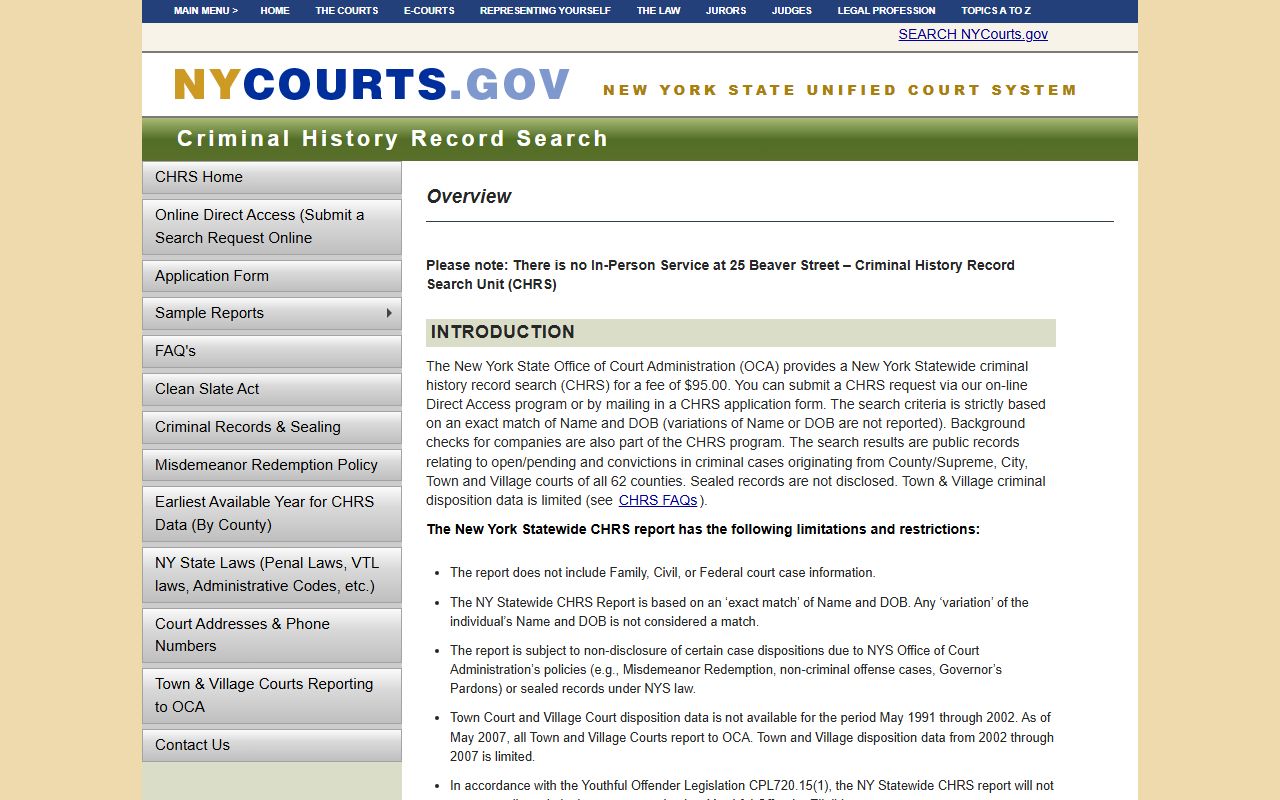
The Criminal History Record Search (CHRS) through the Office of Court Administration is for statewide searches. The fee is $95. You submit a request with the person's full name and date of birth. OCA checks all courts in the state and sends back a report. This is an exact-name match, so you need the right spelling. Submit requests through the OCA CHRS portal.
For certified copies or the full case file, visit the court clerk in the borough where the case was heard. Bring valid photo ID. Staff can pull records and make copies on the spot. The fee for a Certificate of Disposition is typically $10. This document shows the final outcome of a case and is what most people need for court proceedings or legal filings.
You can also file a Freedom of Information Law (FOIL) request for police records through the NYC 311 portal. NYPD arrest reports and incident reports are handled through this process. Court records are not subject to FOIL since courts have their own rules for public access under Judiciary Law 255.
Record Sealing in New York City
New York has strict rules about when criminal records get sealed. Under CPL 160.50, if a case ends in a dismissal, acquittal, or other favorable outcome, the records are automatically sealed. The court, police, and prosecutors must all seal their files. No public access is allowed after that.
CPL 160.55 covers cases that end with a non-criminal conviction like a violation or traffic infraction. These records are also sealed from public view. Only law enforcement and certain agencies can see them.
For cases that ended in a criminal conviction, CPL 160.59 allows some people to apply for sealing. You can ask the court to seal up to two convictions if at least ten years have passed since the sentence ended. Only one of those can be a felony. Drug offenses and certain other crimes may qualify. The court looks at factors like the nature of the offense, your criminal history, and your rehabilitation.
CPL 160.58 is for drug-related cases. If you completed a drug treatment program as part of your sentence, the court can seal the record. This helps people in recovery move forward without a criminal record showing up in public searches.
Sealed records do not show up on WebCrims or CHRS searches. If you believe your record should be sealed but it still appears, contact the court clerk in the borough where the case was heard.
New York City Criminal Court Records Fees
Fees vary depending on what you need and where you get it. The most common requests and their costs are listed here.
- OCA Criminal History Record Search: $95
- Certificate of Disposition: $10 per case
- Certified copies of court documents: $1.25 per page
- County Clerk search fee: $5 per two years searched
WebCrims is free. There is no charge to search pending case information online. If you need official documents for court or for a legal matter, the certified copy from the clerk is what you want. Plain copies cost less but may not be accepted for legal purposes.
Fee waivers are available for people who can't afford to pay. Ask the court clerk about the process. You will need to show proof of income or public benefits.
Legal Resources in New York City
New York City has many free and low-cost legal services for criminal matters. The Legal Aid Society is the largest provider of free legal defense in the city. They handle cases in all five boroughs. If you were assigned a Legal Aid attorney during your case, you can call them to get information about your records.
The New York City Bar Association runs a lawyer referral service. They can connect you with a criminal defense attorney for a low initial fee. The DCJS Record Review page has information about how to check your own criminal history and how to challenge errors in your record. The New York State Bar Association also offers a statewide lawyer referral program.
For record sealing specifically, organizations like the Legal Action Center and Bronx Defenders help people apply under CPL 160.59. Many borough-based legal services groups offer clinics where you can get help with the sealing application at no cost.
New York City Criminal Court Records by County
Each borough in New York City is a separate county with its own court system. For detailed information about criminal court records in a specific borough, visit the county page. The county courts handle felony prosecutions while the NYC Criminal Court handles misdemeanors across all boroughs.
Nearby Cities
Other cities and towns near New York City also have criminal court records pages. Many residents in these areas have cases that touch the NYC court system as well.